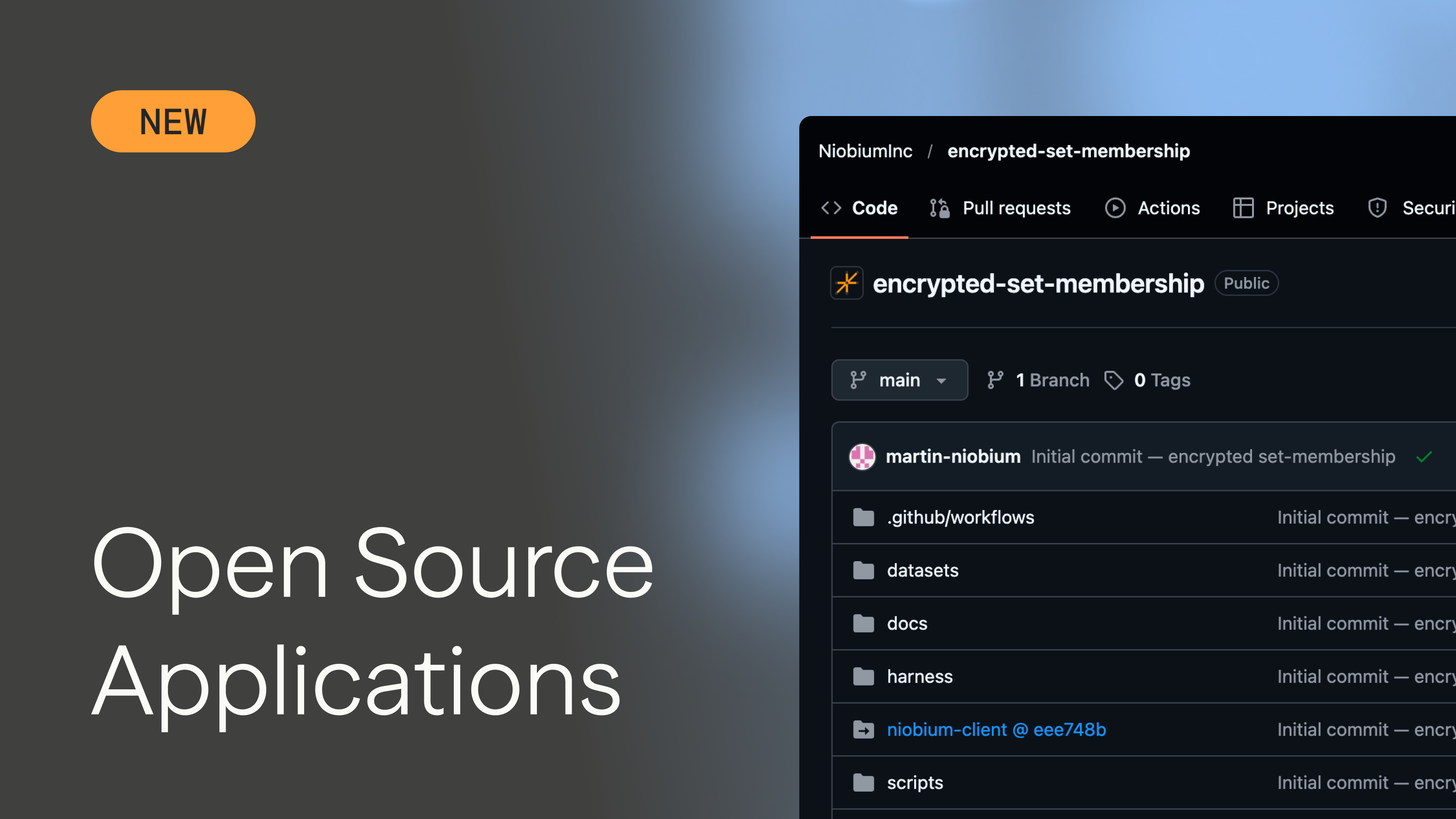
Over the summer we open sourced our FHE developer tools. Today we're sharing more applications that we've been building using those tools. We’re also opening those applications to outside contributions and accepting and reviewing GitHub issues. Each application runs on the Fog™, Niobium’s encrypted cloud for fully homomorphic encryption (FHE) to process sensitive data without decrypting it.
Over the next few weeks we'll be publishing deeper dives on each of these applications to outline what they do, how they work, and potential alternative use cases.
The repositories
Niobium Skills: Our AI skills marketplace. Currently, it features our FHE design skill. The skill is designed to work with any standard coding agent, including Claude Code, Codex, Cursor, Gemini CLI. It walks an agent through the same eleven stages we use ourselves, from defining the privacy model to building a cleartext twin version of the application for debugging, to Fog deployment. The applications created with the Skill are built to run on the Fog using the Niobium Client, which can be built locally or run in a docker container included with the skill.
Fog Starter Kit: Our “Hello World” for FHE. This repo includes a collection of workloads for learning the basics of FHE and the Fog. Including each of the core operations of FHE, the trust boundary between your machine and the Fog, and the compile-once-run-many model built using the FHETCH intermediate representation. The starter kit includes instructions on how to modify the provided code, and what outputs to expect. The last step involves installing the design skill and building an application of your own.
Fetch by Similarity: A client sends an encrypted query to a server holding a vector database and gets back the records above a similarity threshold. The cosine similarity is computed on ciphertext, so the server learns neither the query nor which records matched. This is our fork of the HomomorphicEncryption.org benchmark workload, restructured for the Fog, and the basis of the encrypted semantic search application coming to the Fog.
Encrypted NID: Runs the KitNET anomaly detector from the Kitsune project under FHE to evaluate encrypted network traffic. The client extracts features from a packet capture and encrypts them, the server scores every packet on the ciphertext, and the client decrypts the scores, matching the performance of the original plaintext model. Google also compiled the Kitsune system with Niobium using HEIR and featured it on its security blog. The process we used to build the anomaly detector served as the motivation for creating the FHE design skill.
Encrypted ML Inference: An encrypted image classifier: the client encrypts the pixels, the server runs a multilayer perceptron over the ciphertext, and the client decrypts the label. This repository is also a fork of the HomomorphicEncryption.org ML inference benchmark, whose task is MNIST digit recognition.
Encrypted Credit Card Fraud Detection: The client sends one encrypted transaction, the server runs a fraud model it holds in the clear, and the client decrypts the verdict. The hardened model and dataset came from hardshell.ai. Google compiled a sigmoid version of the model with HEIR, also featured on its security blog for encrypted AI. Our version is a ReLU network, retrained with batch normalization so its activations stay inside the range a degree-5 polynomial can cover, and compiled by HEIR to OpenFHE for the Fog.
Encrypted Set Membership: Determines whether an entry is on a list held by someone else, without the server seeing the query. The client encrypts the entry, the server compares it against every entry on its list under encryption, and the client decrypts the answer: 1 for a match, 0 for no match. Our demo lists are built using up to a million famous names from Wikipedia. A phonetic mode matches names by how they sound rather than how they are spelled, so "Jaymz Smyth" finds James Smith.
Build With Us
We’re looking forward to accepting contributions, issues and feedback. Change the data, improve our models, suggest a circuit optimization, or build something else on top of them. The Niobium FHE Developer Discord is where our engineers answer questions.
We're excited to see what you build!
To learn more about FHE, hardware acceleration, and Niobium's encrypted cloud platform, The Fog™, contact us or sign up to join our Developer Partner Program.