Written in conjunction with our CTO, David Archer, PhD
On Independence Day, we in the USA celebrate the idea that our freedoms are worth protecting. 250 years on, that principle holds, even though the threats to freedom in 2026 look nothing like they did in 1776.
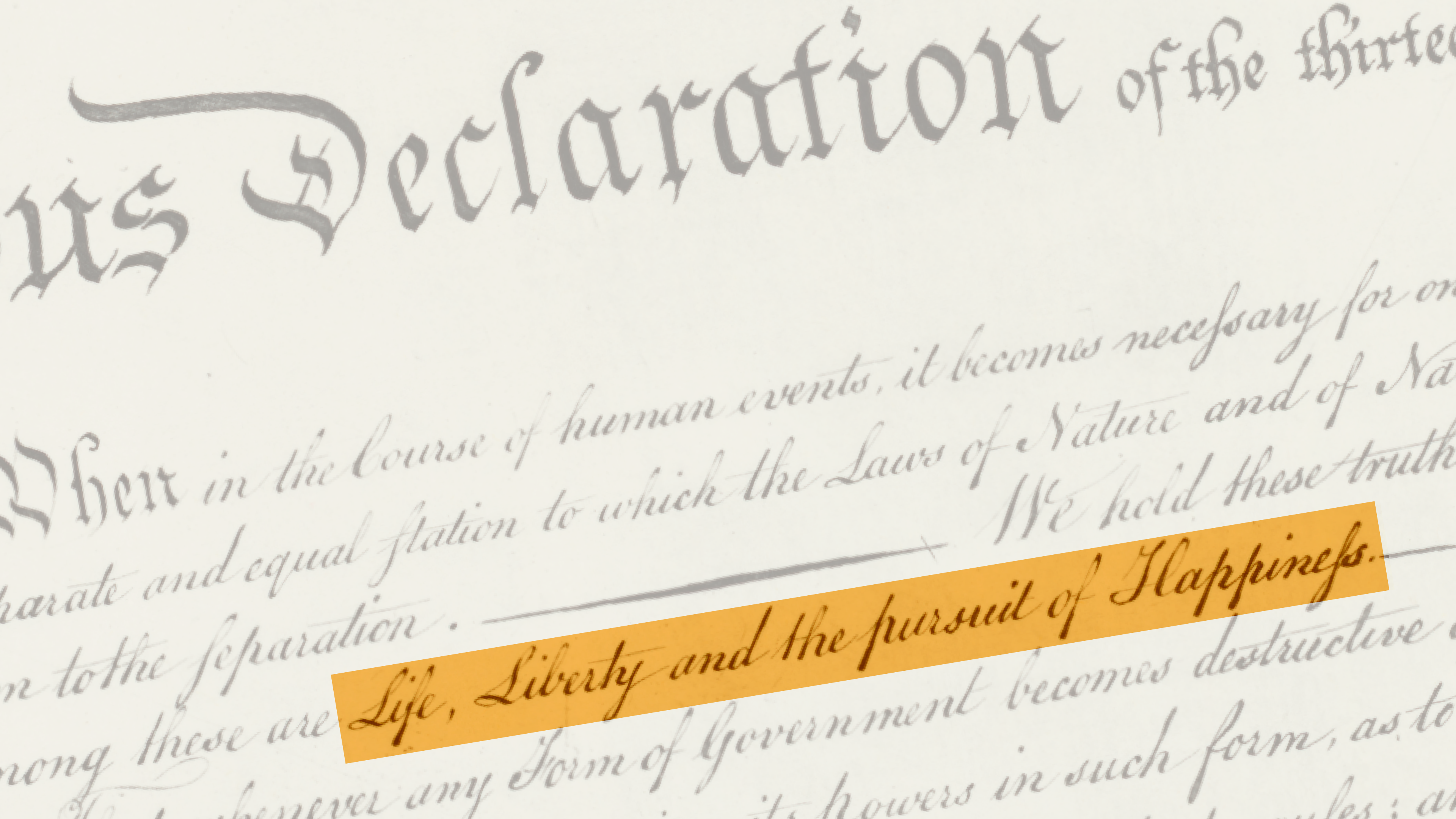
Take for example the notion of personal privacy. In the preamble of the Declaration of Independence, the operative freedoms are "Life, Liberty and the pursuit of Happiness." The last of these, Jefferson’s substitution for Locke's original idea of freedom of "property", might implicitly refer to freedom from government or organizational intrusion, but that's a retrospective reading with no supporting evidence: in 1776, we didn’t recognize privacy as a freedom to be guarded, because the technology to exploit it didn’t exist yet.
Fast forward to 1890, when a young practicing attorney in Boston, motivated by the novel technology of instantaneous photography, and inspired by his departing legal partner, wrote The Right to Privacy to raise the issue of outside intrusion into personal life. But it wasn’t until Louis Brandeis had been on the Supreme Court for 12 years that he got to constitutionalize the concept of privacy in his dissent in Olmstead v. United States (1928), the wiretapping case. Those 38 years brought the first notions of privacy, and the first threats against it, into stark relief.
From then to now, personal privacy has been both increasingly discussed, and increasingly under threat by new technologies. Even so, privacy is difficult for individuals to fight for, in part because we as a species are very poor at risk assessment; and in part because relatively few put in the effort to understand and counteract the technologies that pose that risk.
Enter a prospective defender, the corporation. For years, those entities were encouraged to collect less personal information because protecting privacy was the right thing to do. Privacy advocates weren’t wrong, but that argument never fundamentally changed corporate incentives. Let’s switch gears then, and speak perhaps in the only terms they are built to understand: assets and liabilities.
If your business collects personal data, you’re holding a liability you may not have priced correctly. Not a future liability. A present one that’s growing on your balance sheet right now. The data you’ve spent years accumulating because it was an asset has quietly become one of the most expensive things you own. Once that becomes obvious, protecting privacy stops being a distant question of corporate goodwill. It becomes instead the kind of in-your-face profit and loss question that comes directly from shareholders.
That’s why we’re optimistic this Independence Day: protecting personal privacy and operating a business are finally starting to point in the same direction.
For years, personal data was treated solely as a corporate or government asset. Credit card numbers. Purchase histories. Medical records. Browsing behavior. Genetic information. Proof of identity. The corporate assumption was opportunistic: the more data a company collected, the more valuable that company became. The government assumption was simply naive: “of course our citizens’ data will be safe with us.”
But as it turns out, every asset carries risk, and personal data carries a kind of risk unlike almost anything else on the balance sheet. Personal information can be stolen, leaked, subpoenaed, misused, or exposed in a breach. The more sensitive personal information an organization accumulates, the more liability it takes on. At a certain point, personal data stops behaving like an asset and starts behaving like HAZMAT: valuable, but expensive to store and dangerous to mishandle.
For a long time, corporate cyber insurance softened much of that risk. A breach occurred, a claim was filed, losses were absorbed, and business moved on. Insurance premiums became another cost of operating in a digital world.
That insurance math is beginning to change, however. As privacy regulations continue to expand, from GDPR to the growing number of state privacy laws across the United States, insurers are re-evaluating what they’re willing to cover. When a breach involves information that wasn’t collected, stored, or protected in accordance with the law, insurance isn’t always enough. Companies are increasingly left to absorb regulatory penalties, legal costs, reputational damage, and the financial consequences of losing customer trust. The safety net isn’t disappearing, but it’s becoming much smaller precisely where organizations are most exposed.
The one tremendously sad point is, of course, that government agencies accrue very little such risk, and far less than would accrue to a private company in the same position. The structural reason is sovereign immunity: a government agency can only be sued to the extent the agency has consented in law to be sued. It’s nice work, if you can get it. So let’s set aside the government accountability issue for now and get back to corporate risk, where these changing economics are reshaping corporate incentives.The smartest long-term strategy isn’t collecting more personal information. It’s collecting less. Every piece of sensitive information a company chooses not to retain removes a piece of liability. But deleting such data is far harder than anyone wants to admit. The liability is not removable simply by pressing the DEL key on the corporate keyboard.
There is an option, and an increasingly viable one: if a company can perform the computation it needs without ever seeing the underlying data, much of that liability disappears. You can’t leak information you never possessed in readable form. You can’t surrender information you were never able to access. You can’t lose information that was never exposed in the first place.
Privacy and business objectives used to look like opposing priorities. This new calculus shows that they’re beginning to align, and that alignment accomplishes something no compliance checklist or privacy policy ever has. When the financial incentive is to possess less sensitive information, customers benefit without that benefit having to be the primary motivation.
The technology to make that possible already exists.
Modern privacy-enhancing technologies make it possible to perform useful computation while information remains encrypted. Re-imagine Amazon Search Party without anyone at the service provider ever viewing your doorbell’s video feed. The system produces the answer you need while the footage remains entirely opaque throughout the process: all that is revealed in response to a dog owner’s query is an adjustably vague geographic reference. Even the service provider learns nothing.
The same principle extends far beyond smart doorbells. A hospital can analyze sensitive patient information without exposing medical records. A financial institution can evaluate a loan application without unnecessarily revealing personal characteristics. Researchers can derive insights from genetic data without taking ownership of the genomes themselves.
With that kind of technology, organizations can generate useful insights without seeing the underlying information. Companies that embrace that shift won’t just reduce regulatory exposure, breach costs, and legal risk. They’ll build fundamentally safer organizations because they no longer need to possess information they can’t afford to lose.
That’s a different kind of independence for individuals, as well as for corporate investors.
The good news is that this approach doesn’t depend on billions of people becoming privacy experts or reading every terms-of-service agreement before clicking “Accept.” Instead, it depends on companies building systems that protect sensitive information by default instead of by exception.
This Independence Day, it’s worth remembering that every generation inherits the responsibility to defend our freedoms, though the threats to those freedoms continue to evolve. Without remembering and taking on that responsibility, those freedoms won’t exist for the next generation to celebrate. Nearly 250 years ago, Americans fought for the right to life, liberty, and the pursuit of happiness. Today’s challenge looks different, but it asks a similar question: how do we preserve individual freedom in a world that collects, stores, and analyzes more personal information than ever before?
Protecting privacy doesn’t have to depend on billions of people making perfect privacy decisions every day. It can come from building systems that don’t require people to surrender their privacy in the first place. When protecting personal information becomes the smartest business decision a company can make, privacy stops being an aspiration. It becomes infrastructure. That’s the kind of independence worth building.
To learn more about FHE, hardware acceleration, and Niobium’s encrypted cloud platform, The Fog™, contact us or sign up to join our Developer Partner Program!